


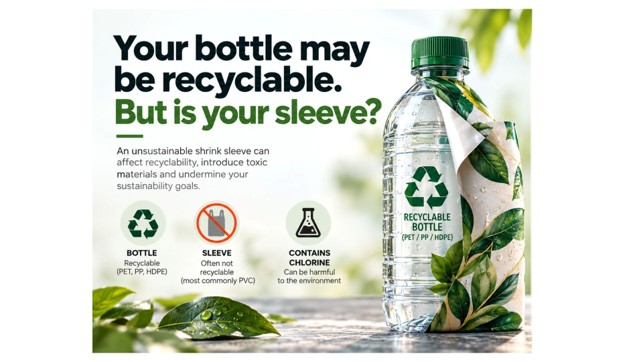
Why brands need to look beyond the bottle and consider the sleeve as part of the complete packaging system.
A bottle can be recyclable. But that does not automatically mean the entire package is designed for recycling.
For years, brands have focused on lightweighting bottles, adding recycled content and improving the recyclability of primary packaging. One component, however, is still easy to overlook: the shrink sleeve.
A shrink sleeve can cover almost the entire container. It carries the brand identity, delivers 360° shelf impact, communicates product information and, in some applications, provides tamper evidence. The film selected for that sleeve can also influence what happens when the package reaches the recycling stream.
The better question is not only “Is our bottle recyclable?” but “Is our complete packaging system designed with recyclability in mind?”
That shift in thinking makes shrink sleeve material selection an important part of a broader sustainable packaging strategy.
Why PVC Shrink Sleeves Are a Sustainability Concern
PVC has long been used for shrink sleeves because it offers strong printability, reliable shrink performance and the ability to conform to a wide range of container shapes.
As brands move towards more sustainable packaging, however, conventional PVC can present challenges. PVC contains chlorine and, when it enters recycling streams intended for other plastics, it can create contamination and processing concerns.
A recyclable PET bottle paired with a conventional PVC sleeve therefore presents a different end-of-life scenario from a PET bottle paired with a sleeve selected with the recycling pathway in mind.
A recycling symbol on the bottle alone does not tell the whole sustainability story. Packaging needs to be considered as a system.
The Bottle and the Sleeve Need to Work Together
Take a typical PET bottle. The bottle itself may be recyclable, but the complete pack can also include a shrink sleeve, printing inks, a seam or adhesive and a cap. Once those components come together, the question is no longer about one material in isolation.
Instead, brands need to consider how the materials behave together when the package reaches the recycling stream. Requirements vary by market and recycling infrastructure, so there is no universal answer for every pack. What remains consistent is that the choice of shrink sleeve material matters.
Sustainable Shrink Sleeve Alternatives to PVC
PVC is no longer the only practical option for shrink sleeve packaging. Today, brands can evaluate alternative substrates according to the container material, shrink requirements, application conditions, visual expectations and intended recycling pathway.
At Taurus Packaging, the shrink sleeve portfolio includes PETG, PET, LDPET, Next PETG, TruCycl and Floatabel, alongside specialty printing and finishing capabilities. This allows material performance, sustainability objectives and shelf impact to be considered together.
1. TruCycl: Designed With PET Recycling in Mind
For brands using PET containers, TruCycl offers a way to consider the bottle and sleeve within the same recycling strategy.
TruCycl is a C-PET shrink sleeve designed with PET recycling in mind and is available with 30% PCR content. For brands already using PET bottles, this creates an opportunity to treat the sleeve as part of the packaging’s recycling strategy rather than as a purely decorative component.
The sleeve should not work against the bottle’s recycling pathway.
2. Floatabel: Designed for Separation
Floatabel takes a different approach. This polyolefin-based shrink sleeve is designed to float during the relevant separation process, helping distinguish the sleeve from certain container materials.
It can be evaluated alongside PET, PP and HDPE containers where separation behaviour is important to the intended recycling pathway. This highlights a useful principle: recyclability depends not only on what a material is made from, but also on how it behaves during sorting and separation.
3. LDPET: Reducing Material Through Higher Yield
Sustainability is not only about what happens after a package is used. It is also about asking whether less material can be used in the first place.
LDPET, or Low-Density PET, addresses that question through material efficiency. Based on Taurus’s product information, LDPET can provide 21% higher yield compared with conventional PET or PETG, helping reduce plastic consumption while retaining the functionality expected from a shrink sleeve. Taurus’s LDPET solution is also identified as APR approved.
For high-volume FMCG applications, even a modest material reduction per pack can become significant when multiplied across millions of units.
4. Next PETG: A Practical Path Away From PVC
One concern brands often have when considering a move away from PVC is whether the change will require a completely new packaging process.
Next PETG is positioned as a practical PVC-to-PETG transition option. Taurus reports a 95% success rate in PVC-to-Next-PETG conversions across PP, HDPE and PET containers, together with a low shrink-initiation temperature and a shrinkage curve comparable to PVC.
That matters because a more sustainable material choice is easier to adopt when it can also meet real production and application requirements. The right option still depends on the container, application conditions and required performance.
Does Sustainable Shrink Sleeve Packaging Have to Cost More?
Cost is naturally part of every packaging decision, but comparing only the price per kilogram or price per sleeve can give an incomplete picture.
A more useful assessment considers material consumption, recycling compatibility, production performance, sustainability commitments, retailer expectations, regulatory preparedness and the potential cost of making the transition later.
The question is not simply “Which film is cheaper today?” It is also “Which material makes the most sense for our packaging system tomorrow?”
Sustainability Should Not Mean Sacrificing Shelf Impact
Sustainable packaging does not have to look basic. Shrink sleeves remain a powerful branding format because they can offer full-container coverage, 360° graphics and compatibility with complex container shapes.
Depending on the material and application, brands can also explore matte and gloss effects, metallic finishes, foil, tactile finishes and other embellishments. The goal is not to choose between sustainability and shelf presence, but to balance the right material, the required performance and the desired visual experience.
Design Sustainability Into the Complete Package
Perhaps the most important change is not technological; it is a change in how packaging is developed.
The bottle, sleeve, inks, seam, cap, material combination and available recycling infrastructure can all influence the complete packaging system. That means sustainability teams, packaging developers, procurement teams and converters benefit from considering these decisions earlier in the development process.
Instead of asking at the end, “How can we make this package more sustainable?”, start by asking, “How can sustainability be designed into this package from the beginning?”
Why Consider Moving Away From PVC Now?
For a brand already running PVC successfully, changing the material may not feel urgent. But packaging requirements are evolving. Consumer expectations are changing, recycling systems continue to develop and sustainability targets are becoming more ambitious.
For suitable applications, alternatives such as PETG, Next PETG, TruCycl, Floatabel or LDPET can be evaluated according to the bottle, recycling pathway, application requirements and sustainability objectives. A complete packaging redesign is not always the starting point; in some cases, the first step is simply evaluating whether the current sleeve material is still the best fit.
Five Questions for Your Next Packaging Review
The next time your team reviews packaging sustainability, do not stop at the bottle. Ask:
- What material is our shrink sleeve made from?
- How does it interact with the recycling pathway of our container?
- Is PVC still necessary for this particular application?
- Could we move to a non-PVC alternative while maintaining the required performance?
- Can we reduce material consumption while improving the overall packaging structure?
These questions help move sustainability beyond a claim and turn it into a practical packaging strategy.
The Future of Shrink Sleeves Is Not One-Material-Fits-All
There is no single shrink sleeve material that is automatically the most sustainable choice for every bottle, application or market. That is precisely why material selection matters.
For some brands, the right step may be moving from PVC to Next PETG. For others, it could mean evaluating TruCycl with a PET bottle, exploring Floatabel where separation behaviour supports the recycling pathway, or reducing material consumption through LDPET.
The important shift is to stop treating the sleeve as an afterthought.
Your bottle may be recyclable. But the sustainability story does not end with the bottle.
Rethink the Sleeve. Rethink the Package.
At Taurus Packaging, we work with brands to evaluate shrink sleeve materials based on the container, application requirements, sustainability objectives and desired shelf impact.
If you are currently using PVC shrink sleeves, this may be the right time to explore whether another substrate could better support your long-term packaging strategy.
Talk to Taurus Packaging about finding the right shrink sleeve solution for your product.
